Hello everyone, it’s been a while.

Editorial portrayal of a woman travelling by train through the Irish countryside. This is a representative image and does not depict author Ifeyinwa Nwaejike. The image illustrates the commuting experience described in this article and the contrast between time spent travelling and the landscape observed along the journey.
This post offers a small glimpse into one aspect of my experience living in Northern Ireland, which I remember simply as “The Commute.”
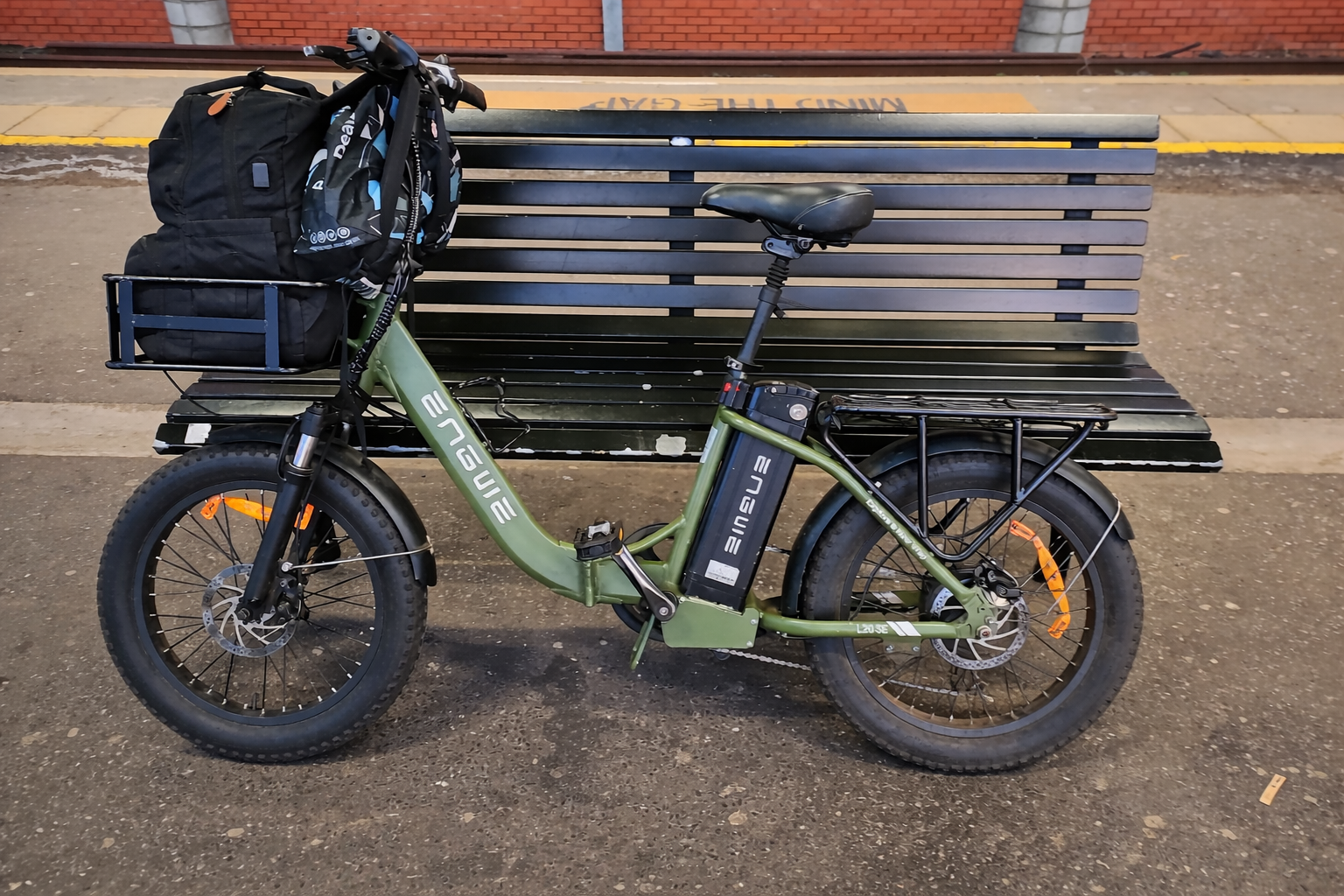
After years of working full time, I returned to full-time education and started a course based in Londonderry, Northern Ireland, even though I live in Belfast. This meant commuting daily from Belfast to Derry by bicycle and train.
The train journey from Belfast to Derry takes about 2 hours and 22 minutes without delays. Before even getting on the train, I would cycle from my home to the Belfast train station, which usually took about 15–20 minutes. Once I arrived in Derry, there was another 10–15 minute cycle from the train station to the institution.
When everything is added together, my daily commute was roughly five and a half to nearly six hours a day if everything went smoothly.
The train journey alone was 2 hours and 22 minutes each way, adding up to 4 hours and 44 minutes per day. When you include the cycling in Belfast and Derry, the total time spent commuting was significant.
The course itself was very full-on. I had to be there for 9am, and it would usually finish around 4pm. Because of the length of my commute, I often used the train journey to work on assignments, especially since I also worked part-time in hospitals in Belfast over the weekend in care-of-the-elderly settings.
Unfortunately, I frequently encountered people on the train who seemed to feel entitled to my time and attention, even though they could clearly see a woman working on her tablet with her headset on. Despite that, they still felt the need to introduce themselves or try to start conversations that I was not interested in.
Let’s just say my overall experience in Derry was not great, although it could certainly have been worse. During my first year, an ethnic minority male student revealed during a year meeting with staff that he had experienced racism that resulted in him being injured.
Personally, living in Northern Ireland for over twenty years—after growing up in Nigeria and moving straight to Belfast—has taught me certain lessons: mind your own business where possible, avoid unnecessary interactions with strangers, plan your journeys carefully, and avoid wandering in unfamiliar places. Always have an exit strategy, a means of escape, or be prepared to defend yourself. Quite frankly, be prepared.
When I first arrived in Northern Ireland over twenty years ago, there were only a handful of ethnic minorities. Thankfully, the numbers have grown since then. However, I still often get the impression that I am expected to be grateful simply for being here, as though I should acknowledge everyone I do not know simply for existing in the same space—even though they did not pay for my airplane ticket from Nigeria to the UK, nor do they pay for my transport and living expenses while I am here.
This is despite the fact that I am a British citizen and never arrived here through asylum or similar circumstances. Yet I am still regularly asked where I “originally came from,” or introduced to every other ethnic minority person around, as though I am automatically expected to socialise with them and act as an unpaid travel guide or hostess.
In the past, people would also tell me about someone they knew who was African during their travels, as though Africa were one small extended family where everyone knows everyone, rather than a continent of over a billion people with countless cultures, traditions, and languages.
Sometimes it feels as though people assume I have endless time and emotional energy to give, as though I am a free emotional therapist or social worker who does not need to be paid for my time or effort.
The institution itself offers counselling and wellbeing services for students, which the university presumably pays for. Yet rather than hiring ethnic minority counsellors or wellbeing advisors, ethnic minority students often end up acting as informal emotional support systems for others. It can sometimes feel as though our time, energy, and needs are treated as though they have no financial value. Over time, that kind of expectation can subtly reinforce the broader societal pattern where ethnic minorities are often paid less than their counterparts, because our labour—emotional or otherwise—is assumed to be freely available.
Looking back, the commute itself was exhausting. But what surprised me most was not the travel.
It was how little understanding there seemed to be for it.
There was one moment during the course that particularly stuck with me. An event was being organised for our year group, and I mentioned that travelling late in the evening would be difficult for me because I was concerned about sexual harassment and unwanted interactions during my commute.
Travelling late on a Friday night, when many people in Northern Ireland are out partying and alcohol is involved, significantly increases the likelihood of encountering drunk or unpredictable individuals. Given the distance I had to travel and the length of the journey, I suggested that the session could simply be held virtually instead of in person.
Instead, my concerns were largely dismissed by both peers and the institution.
Weeks later, Northern Ireland experienced significant tension after a widely reported incident involving a local person being sexually assaulted by an immigrant. The situation escalated quickly, leading to riots and unrest in several places across Northern Ireland. As often happens here, the atmosphere across the region became tense and unpredictable.
Suddenly, everyone seemed to care about female safety.
Yet despite all of that, no one seemed to remember—or show sympathy for—the fact that I had previously expressed concerns about travelling late across the country for a non-essential in-person event that could easily have been conducted virtually weeks earlier.
What struck me most was not the disagreement itself. People are entitled to different opinions.
What struck me was the absence of curiosity or empathy.
It was not as though what I suggested was unreasonable. I simply proposed that the session be held virtually so people would not have to waste time and money commuting all the way to Londonderry for a meeting that could easily have taken place online.
Instead, the emphasis appeared to be on organising a forced year outing, which ultimately turned into what felt like a public relations photo opportunity for the institution.
I used to think it was always a positive sign when universities in the UK featured ethnic minorities in their brochures. Nowadays, however, it sometimes feels as though some institutions are more focused on looking inclusive than actually being inclusive.
There is also a growing culture in educational institutions that encourages communal emotional sharing among students. Ironically, however, these same institutions still charge significant tuition fees while expecting students to provide emotional support to one another in ways that sometimes feel like the institution quietly offloading responsibilities that should belong to its own wellbeing services.
This course placed a strong emphasis on topics such as “consent” and “bystander training.” Yet at times it felt as though those ideas were used to pressure students into accepting unwanted emotional labour from classmates who preferred to unload their personal issues onto people they barely knew, rather than using the university’s professional wellbeing services.
Then, when a student pushes back against that dynamic, they risk being subtly implied to lack empathy.
That might be easier to accept if everyone were operating under the same circumstances. But many of my classmates had the luxurious option of sleeping in because they lived in Derry/Londonderry, while I was waking up early to catch a 6am train every morning, working weekends, and managing an exhausting commute—all while being told to follow the usual “be nice” sermons.
No one asked why the journey might be difficult. No one asked what the commute actually involved. And no one seemed to consider that someone travelling between Belfast and Derry every day might have valid reasons for wanting a bit of flexibility.
Yes, I knew what I signed up for when I agreed to do the course. And frankly, so did everyone else.
That moment was one of those small experiences that quietly reveals a lot about how people see each other.
And perhaps it is also one of the reasons I feel increasingly motivated to use my writing to explore some of the realities of living in Northern Ireland.

Private Property, Public Confidence…..