There’s a version of this story where creating the books is the hardest part.
That version is a lie.
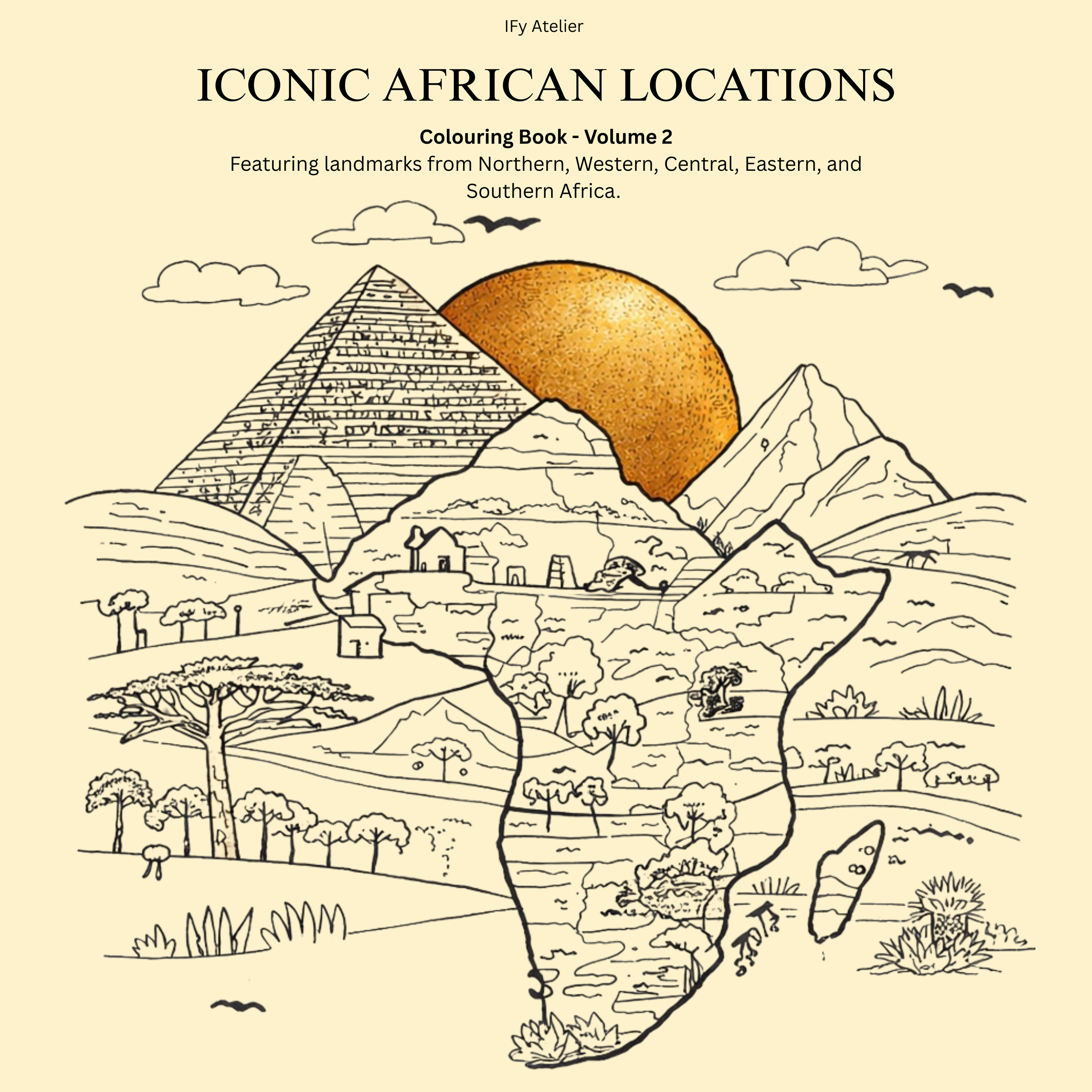
Creating Iconic African Locations — researching landmarks, designing the illustrations, structuring the content — that was the enjoyable part. That was the part that made sense.

What I didn’t fully appreciate at the start was this:
The real work begins after the book is finished.
And it is relentless.

The First Reality Check: Distribution Isn’t Neutral
At one point, IngramSpark restricted my books from distribution in the UK and EU.
Not because of quality. Not because of demand.
Because they were classified as stationery.
That single decision blocked access to entire markets.
What puzzled me wasn’t just the restriction itself — it was what sat underneath it.
When I created the Iconic African Locations series, I wasn’t thinking about novelty or gift items. I had multiple audiences in mind, including elderly adults, particularly those living with cognitive conditions. Colouring is widely used in occupational therapy and dementia care — it supports focus, memory, and emotional regulation.
Each volume contains researched landmarks, contextual information, and cultural insight.
So seeing something designed with that level of intention — educational, representational, and in some cases therapeutic — reduced to the same category as a notepad or basic stationery item was… revealing.
It highlighted how rigid systems can be.
Children’s colouring books are often treated as educational. They are assumed to have developmental value.
Adult colouring books, even when they carry structured content, are not afforded the same consideration.
The classification didn’t just affect distribution.
It revealed an assumption:
that if something is made for adults, it is automatically non-essential.
Ironically, that setback forced me to look at my books differently.
If the system saw them as stationery, then there was an entire category of buyers I hadn’t fully considered — including gift shops and businesses that routinely source stationery-type products.
What initially felt like a limitation became an expansion of how I approached the market.
It didn’t just change where my books could go.
It changed how I positioned them.
The setback also forced me to look elsewhere — and that’s how I found BookVault.
Better paper quality. More suitable for colouring books. Cleaner production.
And then another unexpected discovery:
BookVault integrates with Amazon.
Which completely changed how I started thinking about future volumes.
What looked like a setback was actually a reroute.
The Second Reality: Distribution Is a Puzzle, Not a Pipeline

Editorial portrayal of a woman navigating the complexities of running a publishing business. This is a representative image and does not depict IFy Atelier founder Ifeyinwa Nwaejike. The imagery used throughout this article intentionally portrays women of different races, skin tones and hair textures, reflecting the diversity of women in business and entrepreneurship. Here, the maze symbolises the often complicated systems of distribution, retail, compliance, pricing and market access that independent publishers must navigate.
Getting books into the system is one thing.
Getting them to move is something else entirely.
Through Gardners Books, my books are now available to retailers across the UK and EU.
But “available” does not mean “ordered.”
It means:
A retailer can order
If they choose to
After internal approvals
Which can take 2 to 5 weeks
Or never happen at all
There is no guaranteed flow.
Just access.
The Third Reality: Outreach Is Brutal

Editorial portrayal of a woman managing the challenges of building a business. This is a representative image and does not depict IFy Atelier founder Ifeyinwa Nwaejike. The imagery used throughout this article intentionally portrays women of different races, skin tones and hair textures, reflecting the diversity of women in business and entrepreneurship. This scene represents the quieter frustrations of entrepreneurship, including outreach, waiting for responses and trying to create opportunities.
Before starting this, I underestimated what outreach actually means.
It is not:
sending a few emails
waiting for replies
closing deals
It is:
researching over 100+ businesses globally
identifying the right contact (if one exists)
drafting tailored emails
sending them
following up
and hearing… almost nothing back
A few responses. Mostly silence.
And even the interested ones move slowly — because institutions don’t operate on your timeline.
The Fourth Reality: Pricing Is Not Fully Yours to Control

Editorial portrayal of a woman confronting the shifting costs and commercial pressures of running a business. This is a representative image and does not depict IFy Atelier founder Ifeyinwa Nwaejike. The imagery used throughout this article intentionally portrays women of different races, skin tones and hair textures, reflecting the diversity of women in business and entrepreneurship. The exaggerated game imagery and prices are symbolic rather than factual, representing the continual challenge of managing costs, pricing and competing business demands.
This one caught me off guard.
You set a price.
And then… the system does what it wants.
Amazon, raised the price for my book more than I set. So I felt, maybe I should adjust the price to match it. Only for it to increase my book price again — and watched it rise even higher than I set it.
On other platforms, I’ve seen:
old prices still appearing in search results
new prices only showing after clicking through
different retailers listing completely different prices for the same book
So now, pricing isn’t just strategy.
It’s monitoring:
how platforms interpret your RRP
how discounts are applied
how metadata updates propagate (or don’t)
You’re not just setting a price.
You’re managing how multiple systems display, distort, and redistribute it.
The Fifth Reality: Money Moves… Slowly

This is the part no one really talks about.
You can make a sale today.
And not see the money for 60 to 90 days.
Platforms like:
Amazon
IngramSparks
Gardners Books
…do not pay immediately.
So you’re building, marketing, and scaling…
without real-time cash flow.
The Sixth Reality: HMRC, Companies House… and Administrative Chaos
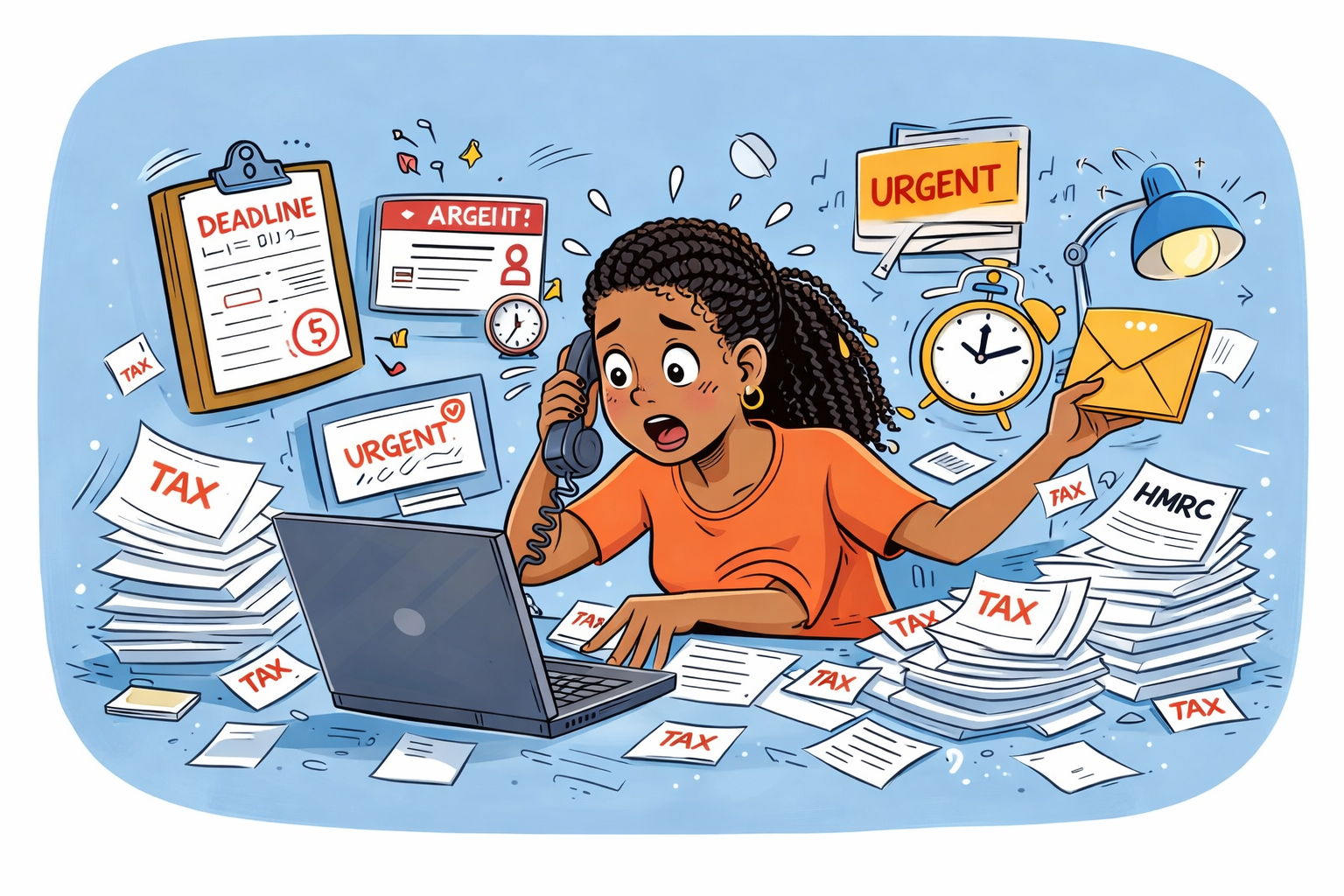
Illustration of a woman surrounded by deadlines, tax paperwork, emails and administrative tasks, representing the competing demands of running an independent publishing business.
And then there’s the part no one warns you about properly:
Government systems.
At some point, you realise you’re not just running a publishing business.
You’re also:
learning how HM Revenue and Customs works
figuring out what Companies House actually expects from you
and trying to understand why everything seems to now live somewhere inside GOV.UK
With updates. Changes. New requirements.
And what feels like… timed windows to do things correctly.
Miss the window?
That’s a future problem waiting patiently for you.
The kind that doesn’t announce itself immediately — but quietly builds into something far more inconvenient later.
There’s also the small detail of trying to understand:
how your books are classified for tax
what counts as zero-rated
what doesn’t
and why something that clearly feels like a book might not be treated like one
It’s not impossible to figure out.
But it does feel like learning a second language.
One where the rules occasionally change mid-sentence.
The Seventh Reality: You’re Building more than Two Things at Once
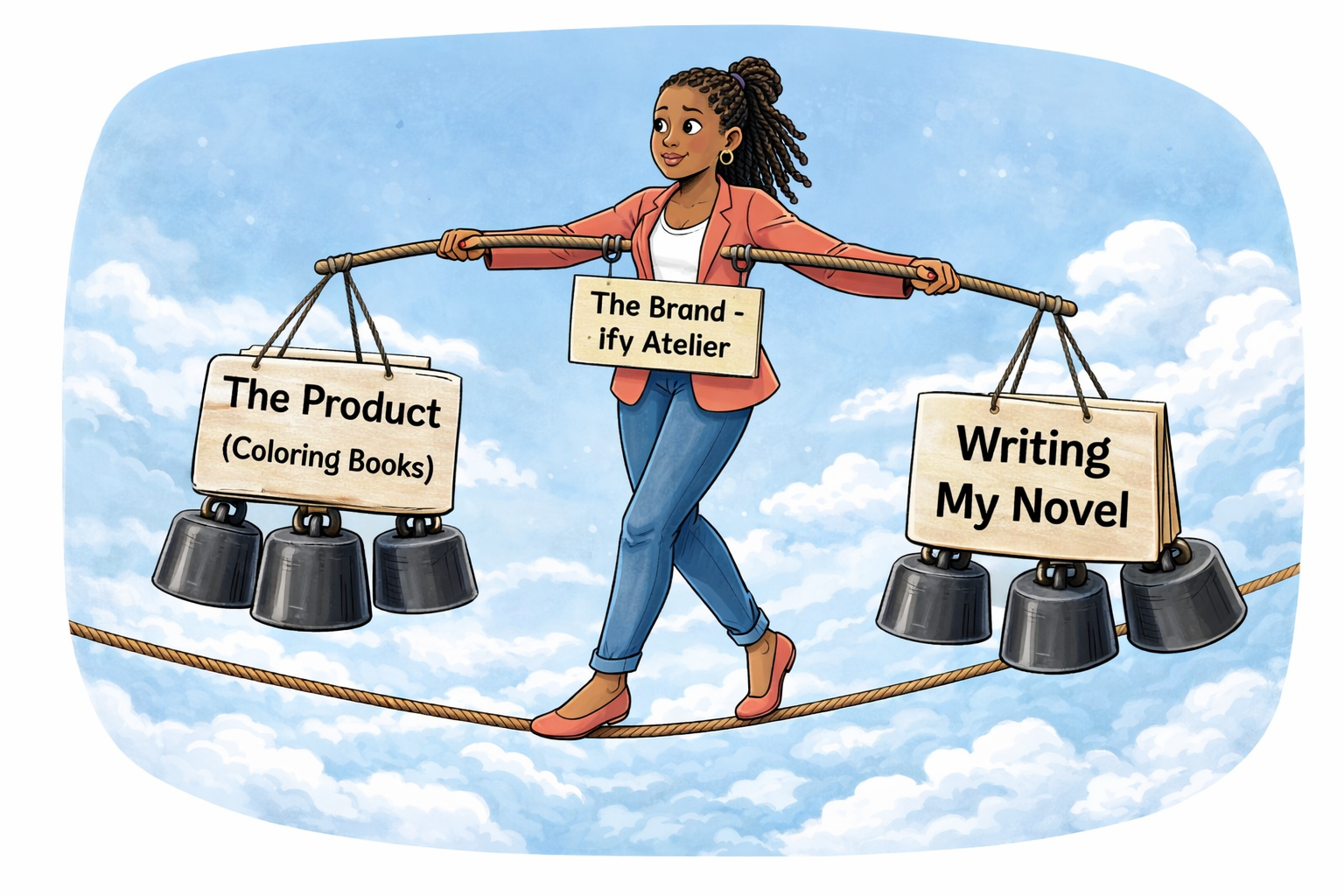
Illustration of a woman balancing on a tightrope while carrying the competing demands of IFy Atelier’s colouring books, brand development and novel writing.
At some point, I realised I wasn’t just selling books.
I was building:
The product (the colouring books)
The brand — IFy Atelier
Writing my novel.
And the second one is harder – in ways that aren’t immediately obvious.
Because people don’t buy from unknown brands.
So now, alongside everything else, I’m:
building awareness
creating content
positioning the brand
figuring out where it even fits in the market
The Eighth Reality: Grants Are Their Own Full-Time Job
Applying for grants sounds straightforward.
It isn’t.
Each application:
takes hours (sometimes days)
requires reframing your work repeatedly
demands clarity on things you’re still building in real time
And after all that?
You might still get rejected.
The Part I Already Knew (But Now Understand Properly)
Going into this, I had a rough expectation:
I would need to reach ~1000 businesses
It would take 6 months to a year to see traction
That part hasn’t surprised me.
What surprised me is how much structure has to be built before traction can even begin.
Where Things Stand Now

Despite all of this, something important has happened.
The foundation is being built.
The books exist
The distribution pathways exist
The systems (even the frustrating ones) are in place
There are still things I’m figuring out — like ARC processes, tax positioning, and scaling distribution properly.
But I’m no longer at zero.
And Now, I Get to Return to the Part I Love

Because once the infrastructure is in motion…
I can go back to:
writing my novel
creating Volume 3 & 4
expanding the world of Iconic African Locations
This time with a much clearer understanding of what happens after creation.
Final Thought
Creating the book is the visible part.
Building everything around it?
That’s the real work.
And most of it happens quietly — behind the curtains.

I’ll admit, though…
I understand why the traditional publishing route is so tempting.
There’s a version of this journey where someone else handles:
distribution
pricing
administration
the endless back-and-forth with systems
And you simply focus on creating.
That version looks very appealing.
But I didn’t choose this path by accident.
I wanted autonomy.
Not just over the colouring books — but over everything I create, including my novels.
I didn’t want to navigate gatekeeping.
I didn’t want to reshape my voice to fit someone else’s expectations, preferences, or unspoken agendas.
Especially not in a time where what is considered “acceptable” can shift depending on who is looking.
I wanted the freedom to create honestly — and let the work exist as it is.
Of course, autonomy comes with its own reality.
You gain control.
And you inherit everything that comes with it.
Including the parts no one advertises.
And even then, there’s one thing you still can’t control:
How people receive your work.
How they interpret it.
What it means to them.
What they choose to do with it — if anything at all.
So in the end, you build the work.
You release it.
And then… you let it move through the world however it will.
Which, when you think about it, is probably the only part of this entire process that was always out of your hands.
If this gave you a clearer picture of what it actually takes to build something like this, you can support the work here:
It helps me continue building IFy Atelier — and documenting the parts no one really talks about.
Or, you can support by:
· subscribing to IFy Atelier Substack
· sharing this work
· or simply following along as this unfolds