On being seen as strong, and expected to carry more than one should.
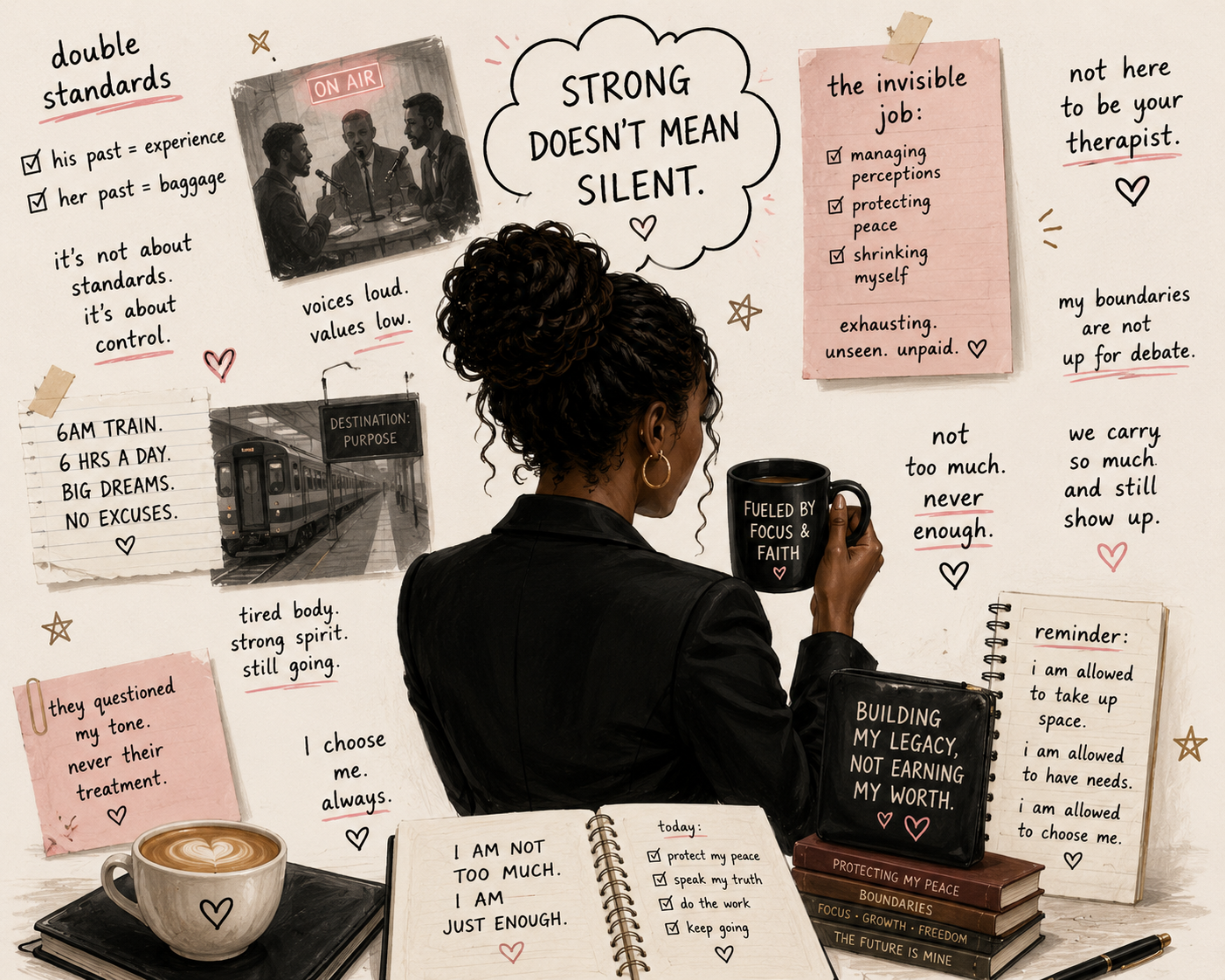
If Part 1 was about what happens when Black women dare to have a public personal life, Part 2 is about what happens in private, in workplaces, in classrooms, in communities, where the same suffocating expectations play out quietly, daily, and without a single podcast calling it out.
Let’s start with the manosphere.
The loudest voices declaring Megan Thee Stallion and Cardi B “unworthy” of commitment belong to a movement that has built entire empires on celebrating male promiscuity. The Black manosphere, a loosely connected network of podcasters, commentators and content creators, has made careers out of bragging about body counts, rotating women, and treating relationships as transactions where men take and women give. These are not men living lives of monastic restraint who stumbled upon some moral framework about women’s virtue. These are men who proudly, publicly, and loudly broadcast their own sexual histories as badges of honour, then turn the microphone around and use the exact same behaviour as evidence that a Black woman is damaged goods.
That is not a standard. That is a weapon.
And it is wielded almost exclusively against Black women. Not against Kim Kardashian, whose entire public profile was built on a sex tape. Not against Taylor Swift or Ariana Grande, whose relationship histories are longer and more public than almost any rapper they have ever criticised. Those women are desired, celebrated, and placed on pedestals by the very same men. The difference, as I said in Part 1, is not behaviour. It never was.
But the manosphere is just the loudest, most visible expression of something that runs far deeper in the Black community. Something quieter. Something that hides behind the language of culture, solidarity, and strength.
The expectation that Black women exist to serve.
Leadership coach Nicola Crooks-Ramgeet described it recently with painful precision. She wrote about how, before difficult meetings, she was not just preparing the agenda, she was preparing her face. Managing how her authority, competence, and emotions might be received. Asking herself: how softly do I say this? How do I keep my face composed? How do I make sure they don’t see they’ve affected me? She called it the invisible job, the second, unacknowledged shift that Black women work simultaneously alongside everything else, in every room they enter.
She wrote: “I realised how much energy I had spent abandoning myself in order to be accepted.”
That line stopped me. Because it is not just about boardrooms. It is about every space where Black women are expected to make themselves smaller, quieter, more palatable, to shrink their needs so that everyone around them can be more comfortable.
I want to share two stories. Not because they are extraordinary. But precisely because they are not.
During my final year of medical school, a Black male clinical educator, a professional in a position of authority and trust, casually told a group of students he was supervising that during his own training, he routinely used his then-girlfriend, now wife, to practise clinical skills on. Not as a willing, enthusiastic partner who had agreed to support his education. Not as an equal. As a resource. Available. Expected. Unquestioned. He spoke about it without a flicker of discomfort, as though removing a woman’s agency so completely was simply part of the natural order of things. As though she existed to absorb whatever he needed, whenever he needed it.
Nobody in that room challenged him. The conversation moved on. And that silence said everything.
The second story is my own.
I was a medical student commuting every single day from Belfast to Derry. My train left Belfast at 6am. The journey one way was two hours and twenty-two minutes. Return was four hours and forty-four minutes. Add the cycling, twenty minutes each way between home and the station, and ten to fifteen minutes each way between the station and the university, and my daily commute alone consumed between five and a half and six hours. Every day. Monday to Friday. On top of a full clinical day that ran from 9am to 3 or 5pm.
The trains ran once an hour. If I missed my 6am train, I waited. There was no flexibility, no grace period, no safety net. I lived in a state of constant low-level fear, the specific, exhausting anxiety of someone for whom one small disruption could unravel an entire day. My body was never fully at rest. It was always calculating, always bracing, always one missed alarm away from catastrophe.
That was my baseline. That was what I was carrying before I even walked through the university doors.
And yet, somehow, an unspoken expectation emerged that I should also be providing emotional support to a fellow Black male student who was struggling. A man I barely knew. A man I had not chosen as a friend. A man whose consistent pattern of attracting drama had made it very clear, very early, that proximity to him came at a personal cost I could not afford.
Nobody formally asked me. Nobody said the words out loud. But the implication was there, hanging in the air the way these expectations always do for Black women. Unspoken. Assumed. Non-negotiable.
What made this particularly infuriating was that support already existed. The university had a wellbeing advisor. The university had a counsellor. The British Medical Association provided a 24/7 counselling service specifically for medical students. The infrastructure was there. Funded. Available. Accessible.
He simply chose not to use it. And chose me instead.
When I raised a formal complaint about the burden being placed on ethnic minority students, and suggested that the university consider hiring an ethnic minority wellbeing counsellor, not as an extra luxury, but as a practical recognition that if the existing provision clearly wasn’t working for some students, culturally competent support might actually help, the university’s official response was that they could not afford it.
Let that sit for a moment.
I was being generous. I was being diplomatic. I broadened the complaint beyond my own experience to advocate for every ethnic minority student who might be falling through the same gap. I gave the university the most measured, constructive, inclusive version of the concern I could have raised.
And they still said no.
They could not afford to address a documented gap in provision that was causing ethnic minority students to absorb emotional labour they had never signed up for. They could not afford to acknowledge that culturally competent counselling is not a diversity nicety but a basic effectiveness issue. They could not afford to take seriously a constructive, solutions-focused complaint from a student who had clearly thought carefully about what she was asking for.
But they could afford to put that dismissal in writing, in an official complaint resolution, as though that was an acceptable answer.
Then came the year gathering.
My year lead insisted on an in-person social event. I raised my objection clearly and practically. Most of my peers lived in Derry. I did not. I lived in Belfast. Attending meant significant travel time and money I had not budgeted for. I suggested a perfectly reasonable alternative: do it virtually. My suggestion was ignored. The year gathering went ahead in person.
What happened next was either breathtaking incompetence or breathtaking indifference. I genuinely cannot decide which is worse.
The gathering was scheduled at 3pm. Immediately after it, at 4:30pm, was a mock exam revision session covering 98 questions. The university’s own policy stated that students should expect sessions to run within 9am to 5pm. That left exactly thirty minutes to cover 98 questions before the 5pm cut off. Thirty minutes. For 98 questions. I will leave you to do that mathematics.
I raised my concerns in the year group chat. I pointed out, as any reasonable person would, that commuting back to Belfast late at night as a woman carried real safety risks, including the risk of sexual harassment. I was not being dramatic. I was not being difficult. I was stating a basic, documented reality about women’s safety in public spaces at night.
My concern was dismissed by my year.
Let me be clear about what I actually said. I made a remark, yes, delivered with the dry sarcasm of someone who had been pushed past reasonable limits, that if someone were to be sexually harassed whilst commuting home late at night because of this scheduling decision, I would make sure, when interviewed by the press, to explain exactly why that person was travelling so late and whose idea it had been to schedule things that way. Something along those lines.
I should not have to explain this. But apparently I do.
Any person who has watched the news, followed a court case, or sat through a single episode of a detective programme knows that when something happens to someone, the first questions asked are: what led up to this? Why were you there? Who else was involved in the decisions that put you in that situation? That is not a threat. That is how accountability works. That is how investigations work. Most victims know their attackers, or their attackers are within their wider circle or random acquaintance. Context always matters.
This is not radical knowledge. This is basic common sense.
Don’t get me wrong, I am no saint. I am very sarcastic when pushed. And I was speaking to peers, most of whom I am significantly older than. But what followed was extraordinary.
My comment was reported. Except it wasn’t reported accurately. The word “harassment,” which I used, was changed to “assault.” Two distinct terms. Two distinct legal and clinical definitions. Changed. And on the basis of that misrepresentation, a disciplinary process was brought against me.
Meanwhile, someone in the group raised the concern that my comments were putting Derry in a bad light. Derry. In a bad light. Because I, a woman commuting six hours a day on a 6am train, living in a constant state of anxiety, raising a legitimate safety concern in a private year group chat, had also said, when explaining why I didn’t want to travel to an unnecessary in-person event: “most of you live in Derry. Thankfully, I do not.”
That statement, made privately among peers, was used as evidence that I was bringing Derry into disrepute.
Like Derry needed any help with that, to be honest.
I did not enrol in a graduate medical school programme to be anyone’s counsellor. I did not wake up before dawn, cycle through Belfast in the cold, catch a 6am train, spend nearly six hours a day in transit, and hold myself together through sheer force of will, only to also manage the emotional instability of a man who had access to professional support and simply declined to use it. I was not his therapist. I was not his carer. I was not his strong Black woman to lean on.
I was a student. Exhausted. Overstretched. Already giving everything I had just to show up.
And these are the future doctors of tomorrow. The people who will one day sit across from patients in emergency rooms. Who will take clinical histories from survivors of trauma. Who will be the first point of contact for some of the most vulnerable people in society.
They could not accurately record what a peer typed in a private chat, nor did they know the difference between sexual harassment and sexual assault, nor did they bother looking it up before filing a formal complaint. They dismissed a woman’s safety concern without a second thought. They weaponised institutional processes against someone who raised a legitimate objection. They prioritised the reputation of a city over the welfare of a student.
Good luck to a rape victim talking to some of that lot.
And this is what the “Strong Black Woman” myth actually costs in practice. It is not a compliment. It has never been a compliment. It is a mechanism for extracting unlimited labour, emotional, physical, psychological, from Black women, while simultaneously punishing them for having needs of their own.
Megan Thee Stallion dared to say publicly that she had been betrayed, that she was hurt, that she deserved better. And grown men, men with platforms, men with audiences, men who share her cultural heritage, responded by making degrading imagery of her, lining up her relationship history like evidence in a trial she never agreed to stand in, and declaring her unworthy of the very love she had clearly given so generously.
The clinical educator’s wife never agreed to be a practice dummy.
I never agreed to be a crisis counsellor.
Megan never agreed to have her private pain turned into content.
But Black women’s agreement has never really been the point, has it?
The manosphere will tell you this is about standards. About protecting the community. About what makes a woman worthy.
It is not. It is about control. About entitlement. About a deep, persistent, collective discomfort with Black women who dare to have boundaries, needs, voices, and lives of their own.
Nicola Crooks-Ramgeet wrote that the shift is not in becoming more acceptable. It is in no longer abandoning yourself to be accepted.
Megan Thee Stallion stopped abandoning herself. Cardi B stopped abandoning herself. And the reaction, the memes, the podcasts, the degrading graphics, the gleeful pile-ons, told us everything we need to know about who actually benefits from Black women’s silence.
Some of us woke up before dawn, cycled through the cold, sat on a train for nearly five hours a day, raised formal complaints, got dismissed, and showed up anyway.
We were never weak. We were never less than.
We were just never given the credit we were owed.
And some of us, exhausted, overextended, still building, still refusing to be quiet, are done waiting for it.
These themes are explored further in the forthcoming Collateral Identity fictional novel series by Ifeyinwa Nwaejike, published by IFy Atelier.