There comes a point when building a business when you realise you may no longer be able, or perhaps should no longer be trying, to do everything yourself.
Apparently, I have reached that point.
When I created IFy Atelier, I always wanted it to become bigger than me.
I didn’t particularly want to spend the rest of my life being the face of the business. The goal was to build something with its own identity, reputation and presence. Something capable of standing on its own while I gradually stepped further behind the curtain and focused on the things I enjoy most: creating, publishing, developing ideas, making strategic decisions and figuring out where the business goes next.
It sounded wonderful in theory.
Then Google AI apparently decided to grant my wish rather earlier than anticipated.
But we’ll get to that.
Me, myself and a few AI tools
Somewhere along the way, Google AI appears to have appointed itself IFy Atelier’s unofficial publicist, brand strategist and slave driver.
I did not hire it. It does not appear to require payment. Unfortunately, it has opinions.
Searching for my own work has become an unexpectedly useful exercise in discovering what the internet currently thinks IFy Atelier is, who it thinks I am and, occasionally, who it thinks I am not.
One search confidently connected me with IFy Atelier, my Iconic African Locationsseries, my writing and Northern Ireland: Two Faces, One Nation. It even began directing people towards my work and asking whether they wanted to know where they could purchase my books.
Lovely.
Then there is Collateral Identity.
My crime thriller, which predates Northern Ireland: Two Faces, One Nation, has apparently been relegated to the digital equivalent of, Oh yes, she is also developing a literary fiction title.
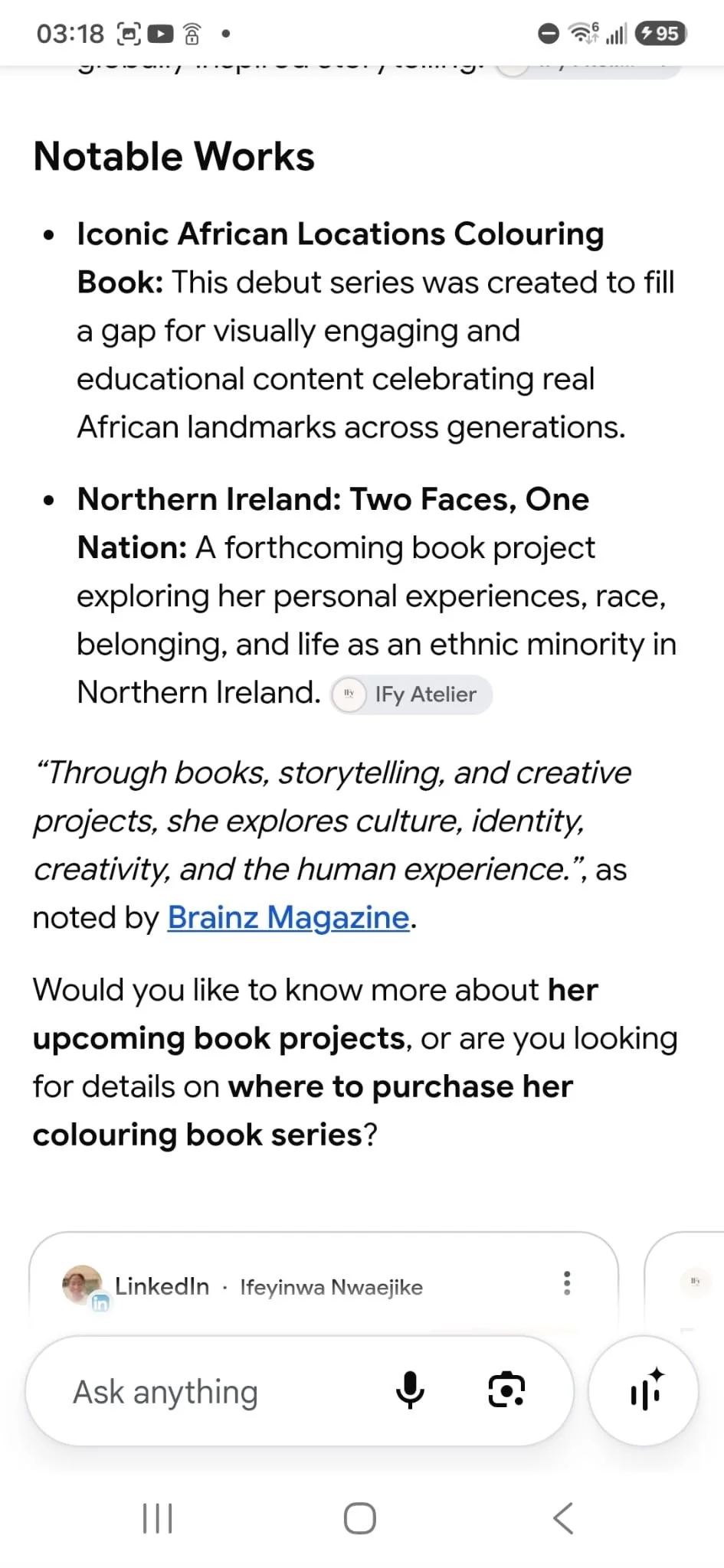
Google AI proudly announcing Northern Ireland: Two Faces, One Nation… whilst apparently forgetting the project that started all of this, Collateral Identity. (6 September 2026)
Excuse me?
The indignity did, however, reveal something useful. If an AI search system can readily identify one project but barely name another, that tells me something about the information I have made publicly available and how clearly I have connected the different parts of my work.
So Google AI’s occasional mischief has started influencing my housekeeping. I have been reviewing image descriptions and SEO on the IFy Atelier website, making the relationship between myself, the studio and its projects clearer, and looking at where individual books need stronger identities of their own.
It is an oddly effective feedback loop.
Google AI: Here is what I think your business is.
Me: You have missed something.
Google AI: Then perhaps you should communicate it better.
Me: You judgemental little shit.
And back to work I go.
A few weeks ago, I found myself in an interesting discussion on LinkedIn with Luis Saro.
Luis had written about organisational failure, pressure and the things developing quietly in the corners of a business that nobody thinks to monitor.
He then asked me a question:
What if the next catastrophic failure in your organisation is already quietly growing somewhere your team doesn’t even think to monitor?
There was one slight problem with the premise.
My “team” currently consists largely of me, myself and a few AI tools.
I told him as much.
I joked that the closest comparison I could think of was Caractacus Potts from Chitty Chitty Bang Bang with all his gadgets, although I would probably argue with mine just as often as Caractacus did with his inventions.
It was funny because it was true.
IFy Atelier may have a growing public presence, books, websites, social media accounts and all the other things that make a business look like a functioning operation from the outside, but behind the curtain there is still one person making an extraordinary number of decisions.
Me.
And Luis’s question stayed with me.
Not necessarily because I thought there was some catastrophic failure quietly developing in a forgotten corner of IFy Atelier, but because it raised a more practical question:
How long can one person realistically keep watching all the corners?
Then somebody offered to sell for me
Around the same time, I received an approach from someone proposing to generate sales for IFy Atelier.
Naturally, I had questions.
Lots of questions.
How would the sales be attributed? What exactly constituted a successful conversion? Who would the prospective customers be? What would he say when representing the business? What would the financial arrangement look like?
The conversation continued.
And somewhere during that exchange, something shifted.
Instead of asking myself whether I should accept one person’s sales proposal, I started asking a different question:
Does IFy Atelier now need a sales function?
That was not something I had planned to seriously consider until later.
Suddenly I was writing IFy Atelier’s first job opportunity.
That felt significant.
My baby was growing up.
Why sales?
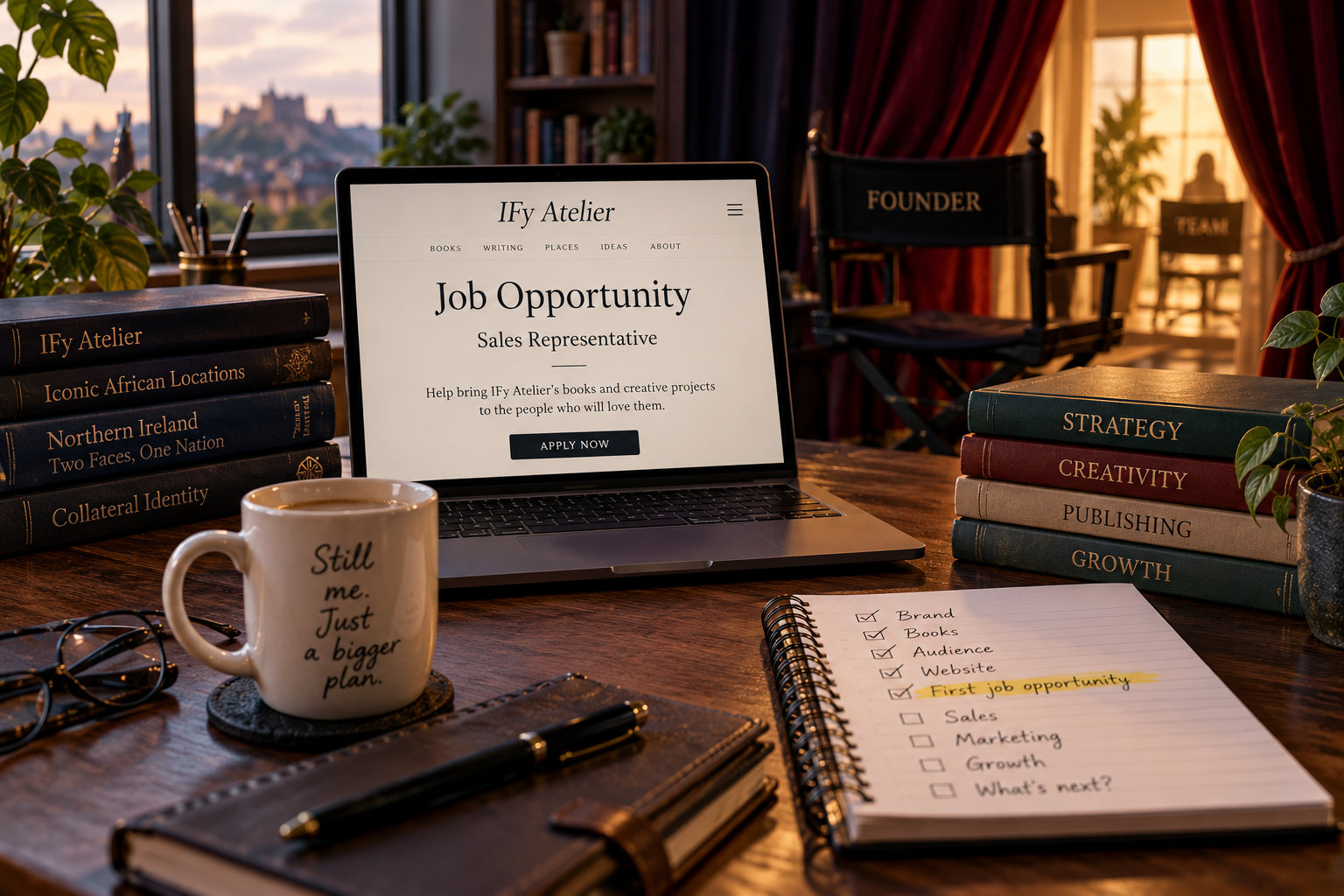
There is a reasonable argument that I should have delegated sales much earlier.
After all, businesses need revenue. You can create wonderful products, build beautiful websites and tell compelling stories, but eventually somebody has to sell something.
Sales is not an optional decorative feature of a business.
But I don’t regret waiting.
When IFy Atelier began, I was still discovering what I wanted it to be.
The brand was developing. Its voice was developing. Its audience was developing. Even my understanding of where I wanted the business to sit within publishing and the wider creative industries was developing.
Handing responsibility for selling IFy Atelier to somebody else at that stage would not simply have meant delegating sales.
It could have meant allowing someone else to help define the business before I had finished defining it myself.
Now I feel differently.
The brand is more established. There is a growing body of work behind it. There is an audience. There are clear values and a clearer sense of what belongs under the IFy Atelier name and, equally importantly, what doesn’t.
That provides a degree of protection.
Someone can now represent IFy Atelier without necessarily having the power to decide what IFy Atelier is.
And that distinction matters to me.
It is also why, somewhat unexpectedly, I think sales may be one of the first major functions I am comfortable delegating.
Marketing is different.
Marketing speaks in the voice of the brand. It shapes how the business presents itself publicly, what stories it tells and how people understand it.
I’m not quite ready to hand that over yet.
Sales, however, can operate within boundaries I establish.
Here is the business.
Here are the products.
Here is what we stand for.
Here is how we describe ourselves.
Here is what you can promise.
Here is what you absolutely cannot promise.
Now let’s see whether you can find the people who want what we have created.
That feels less like relinquishing control and more like building capacity.
Be careful what you wish for
Which brings me back to Google AI.
When I created IFy Atelier, one of my long-term ambitions was to build the business to a point where I wouldn’t have to be its face.
I wanted IFy Atelier to develop an identity beyond me.
Apparently, Google AI heard me.
“Your wish is my command.”
Recently, while looking at how IFy Atelier appeared in Google’s AI-generated results, I discovered that it had used a thumbnail image from one of the IFy Atelier blog posts in a way that appeared to associate the person pictured with me.
I stared at it.
Hang on.
That isn’t me.
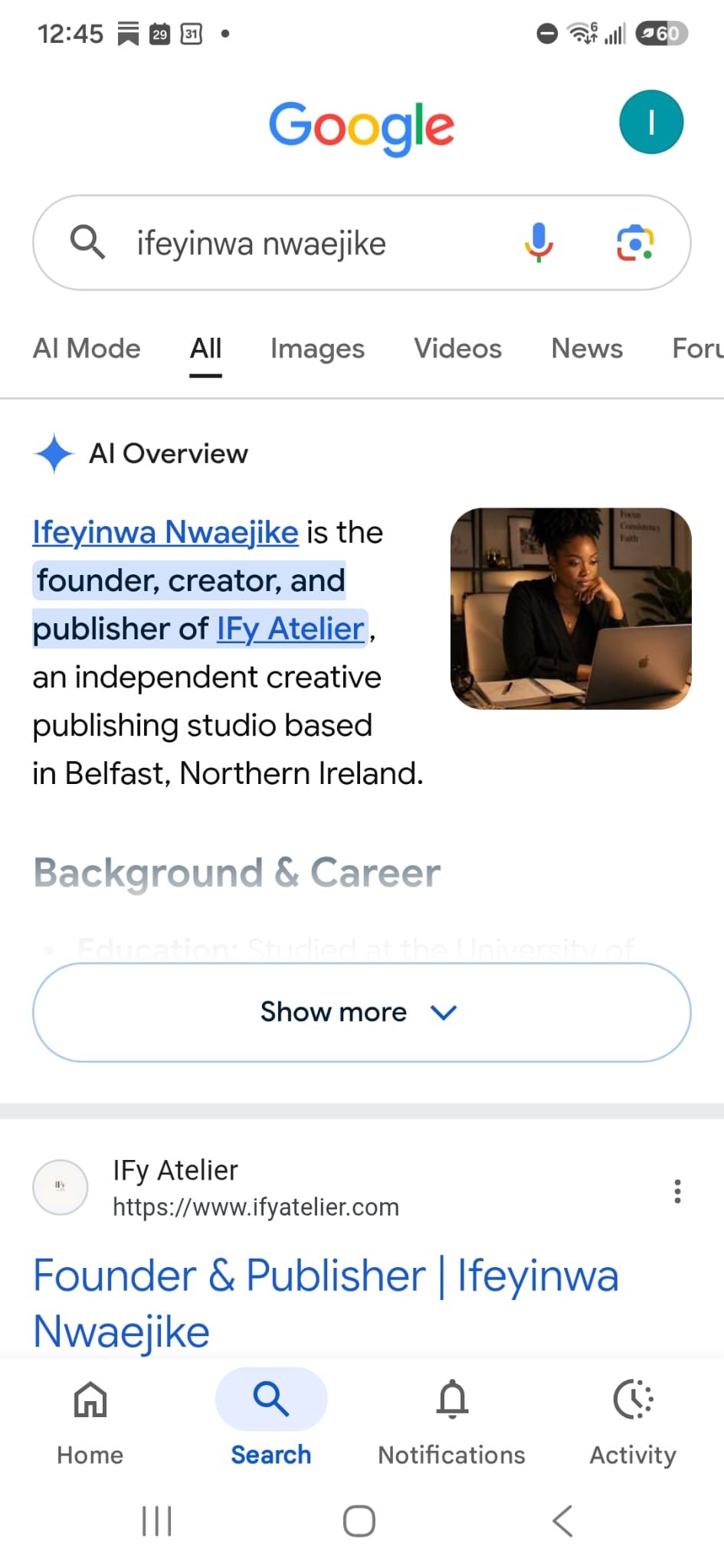
Google AI proudly telling the world what I look like, despite the sources and references it used saying otherwise… (29 September 2026)
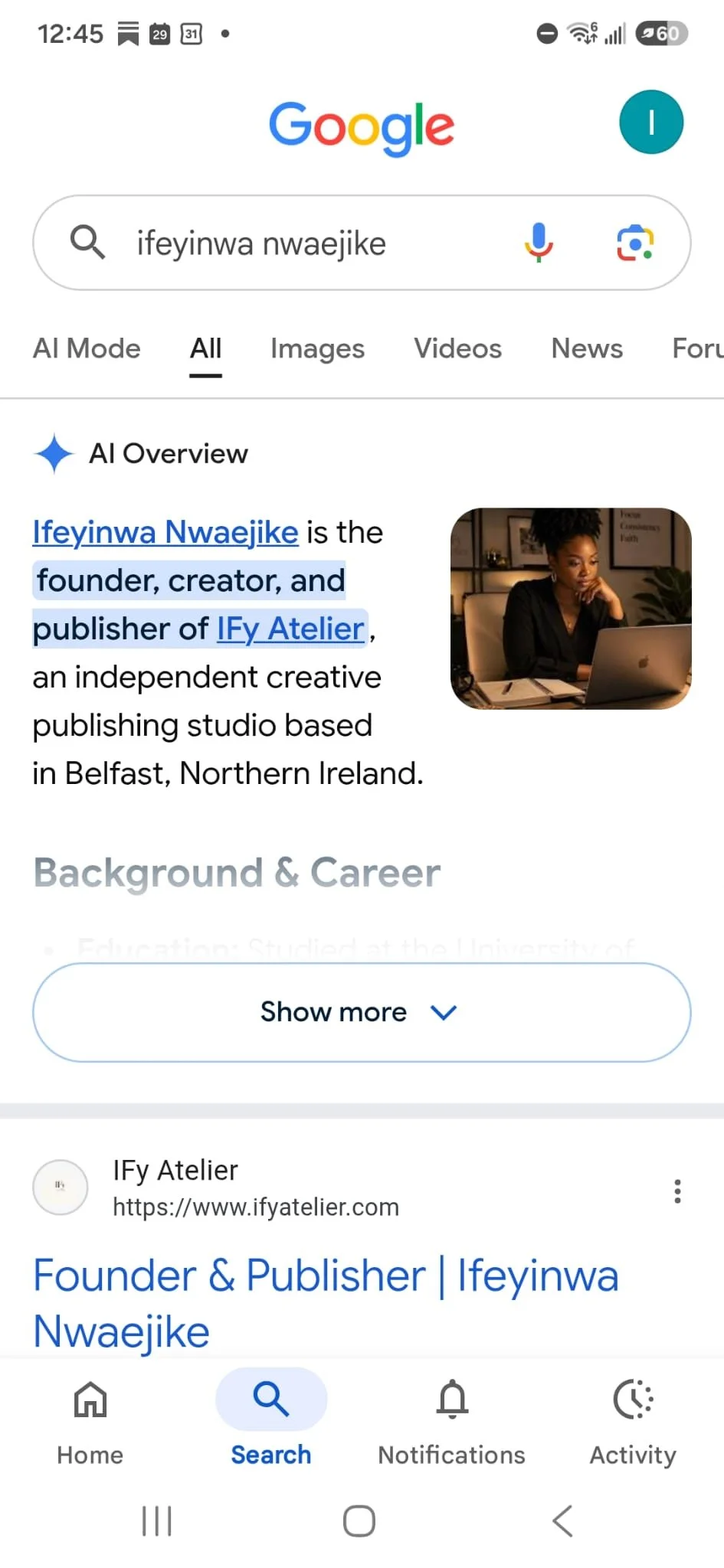
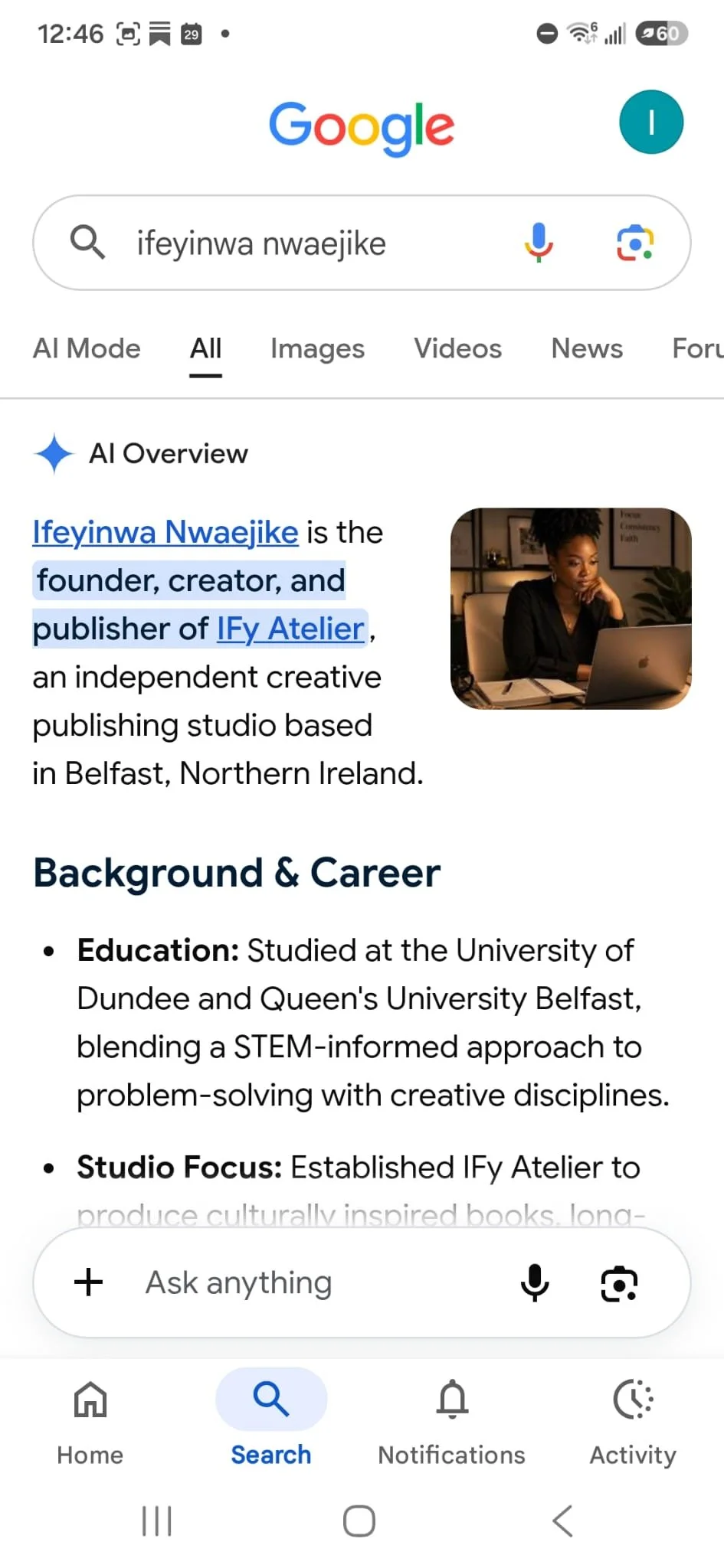
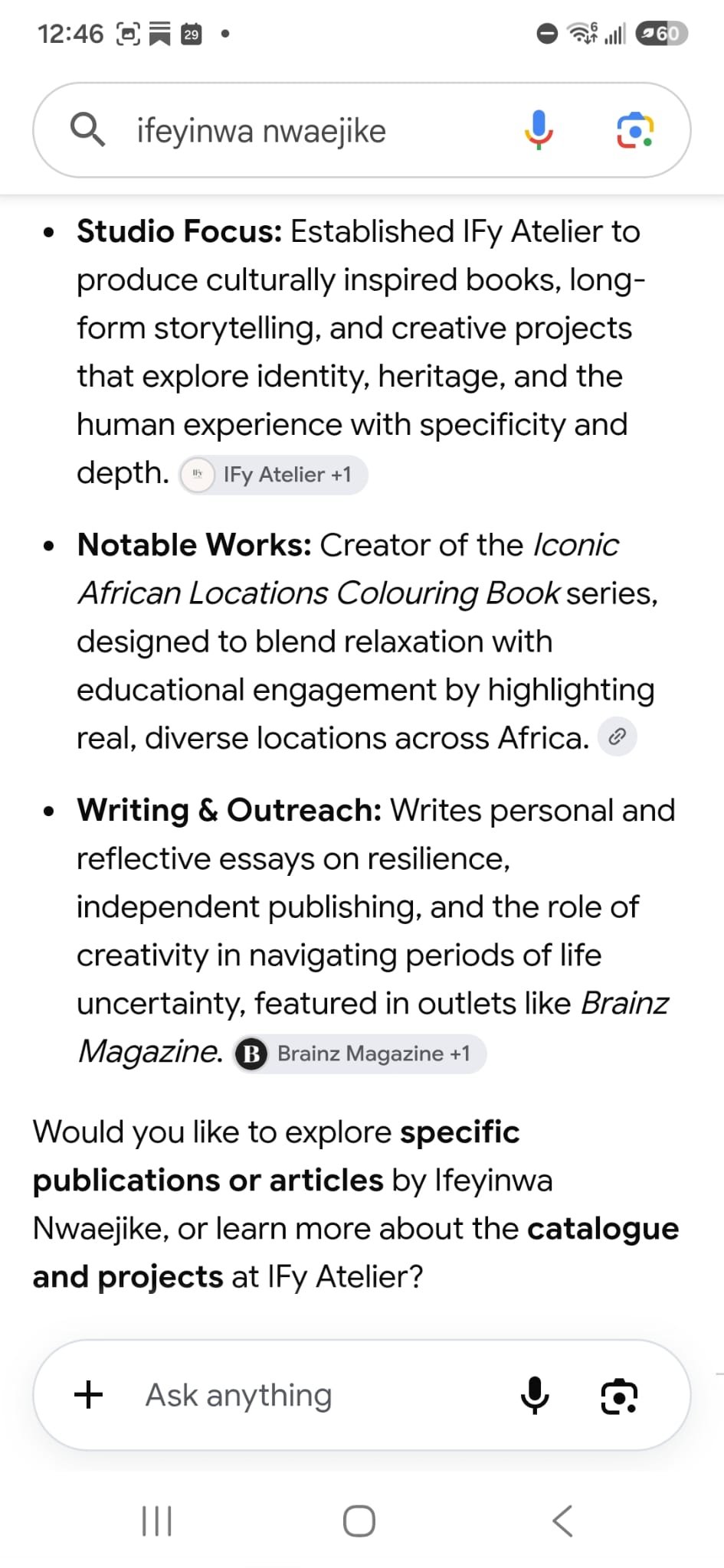
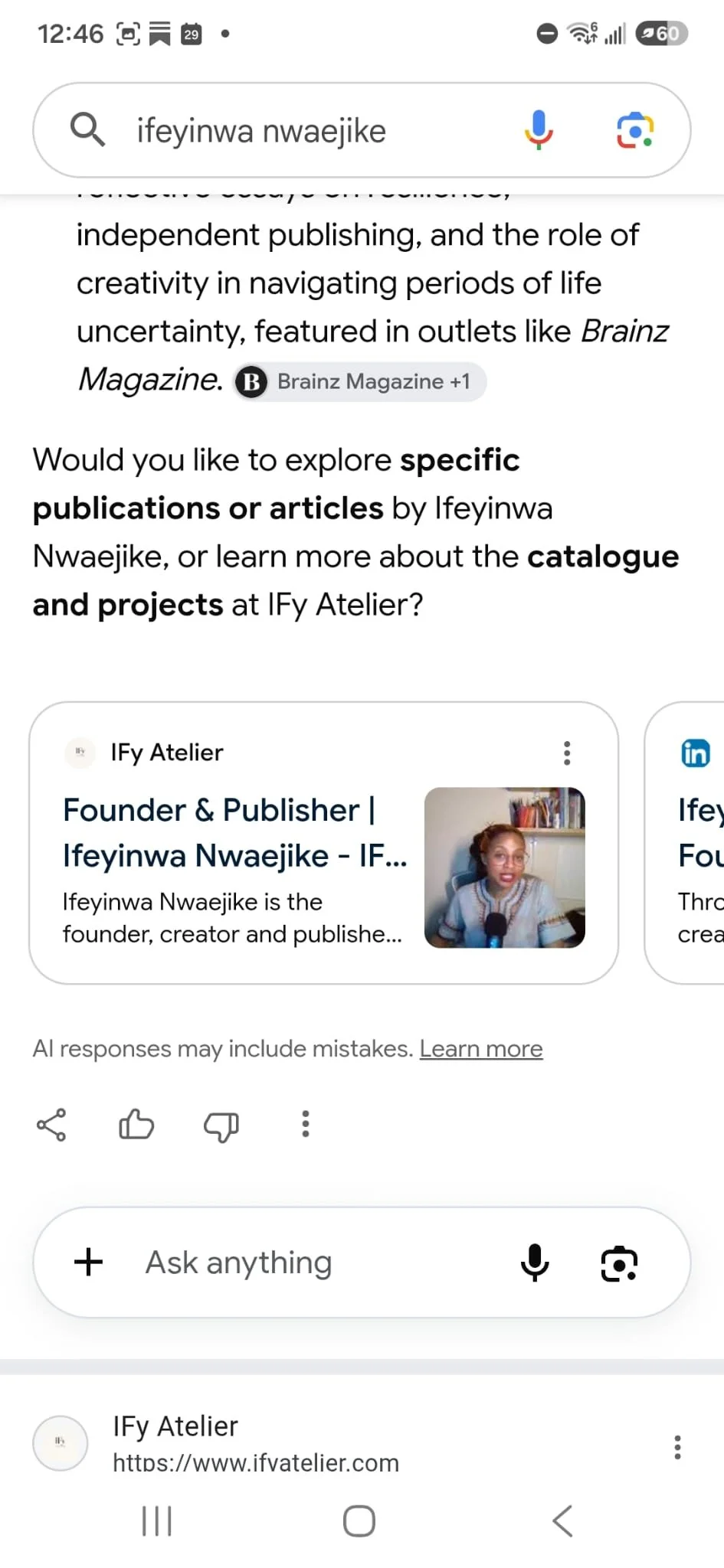
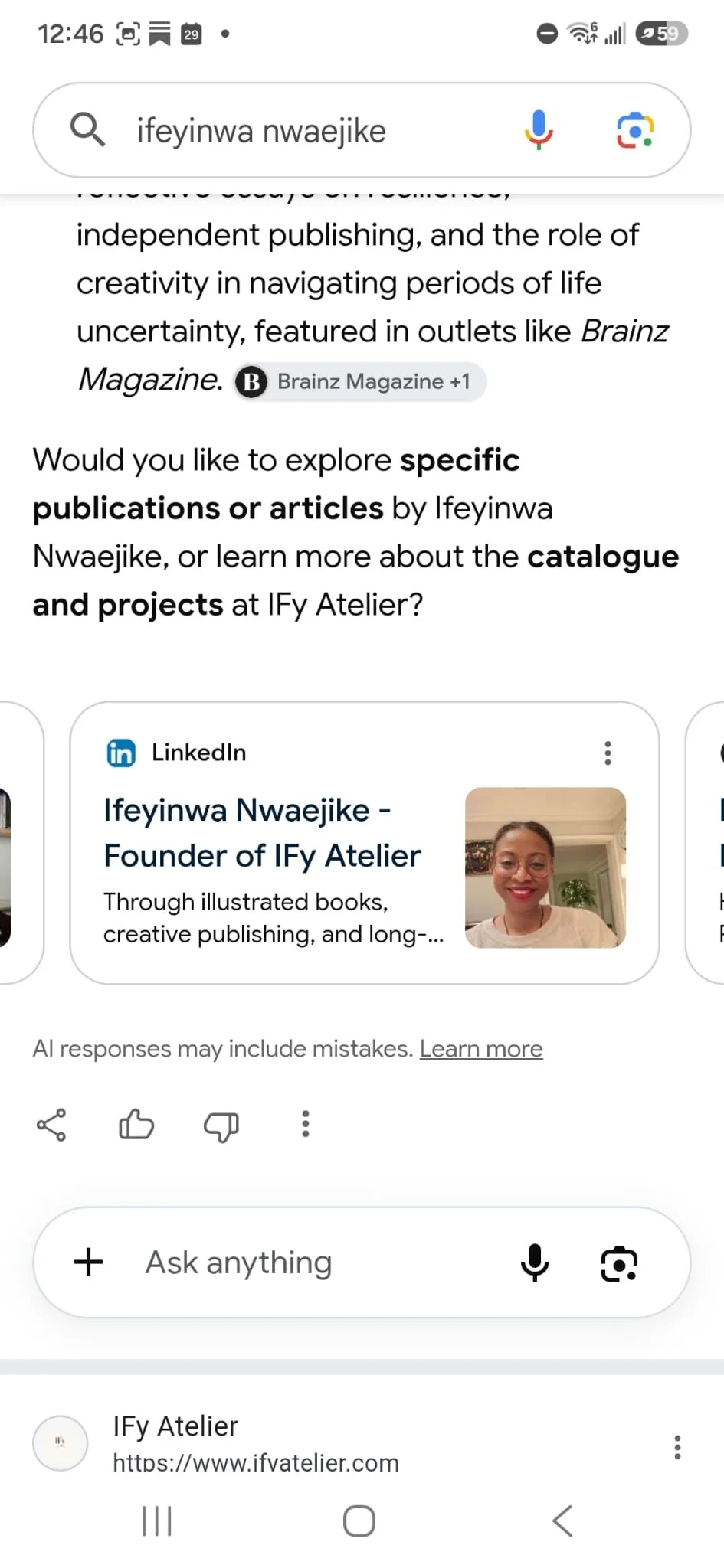
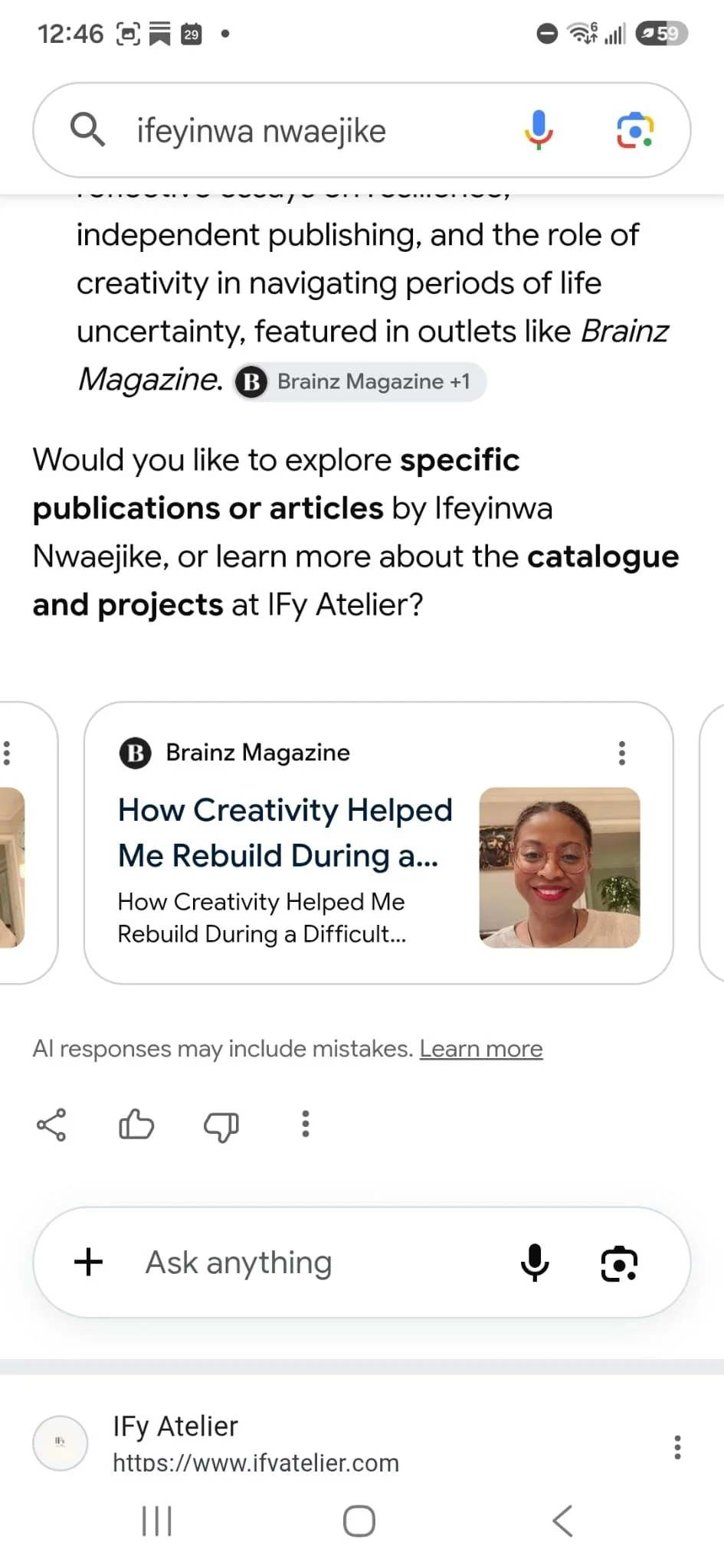
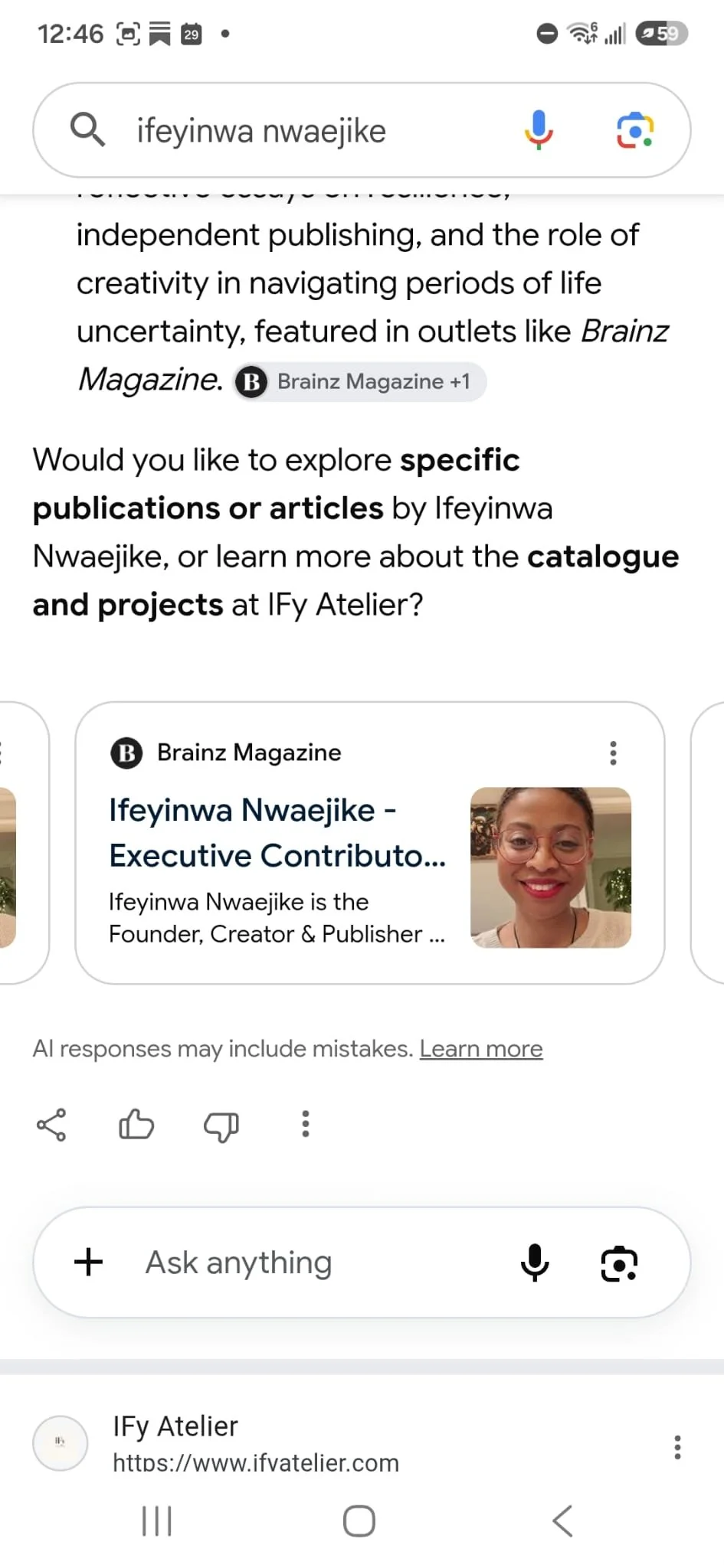
Google AI proudly telling the world what I look like, despite the sources and references it used saying otherwise… (29 September 2026)
And suddenly the woman who had spent months saying, “I don’t want to have to be the face of the business,” had a very different reaction.
Excuse me. I built this bloody thing.
There has been blood, sweat and tears involved here.
Mostly metaphorical blood, thankfully.
There have been late nights, experiments that went nowhere, technical problems, research rabbit holes, marketing frustrations, publishing decisions, administrative headaches, moments of doubt and an absurd number of conversations with AI tools.
I may eventually want to step away from being the public face of IFy Atelier.
That does not mean everybody gets to forget who founded it.
Apparently there is a difference between wanting your business to become bigger than you and watching an algorithm casually erase you from it before you have even hired your first salesperson.
Lesson learned.
The irony did not end with Google.
While Google AI was struggling to connect my actual photograph with my own name and business, Facebook appeared to have considerably more confidence identifying something else: AI.
Most of my IFy Atelier posts are scheduled through Sintra, an AI-assisted platform I use as part of my content workflow. Sintra might provide the initial visual or caption, but that is often only the beginning. I review it. I rewrite it. Sometimes ChatGPT and I pull the wording apart. Most of the time, images get rejected, recreated or corrected. Books mysteriously facing the wrong direction are repositioned. Occasionally, an entirely unfamiliar woman has to be evicted from my own brand imagery.
And after all that?
Published by Sintra. AI content.
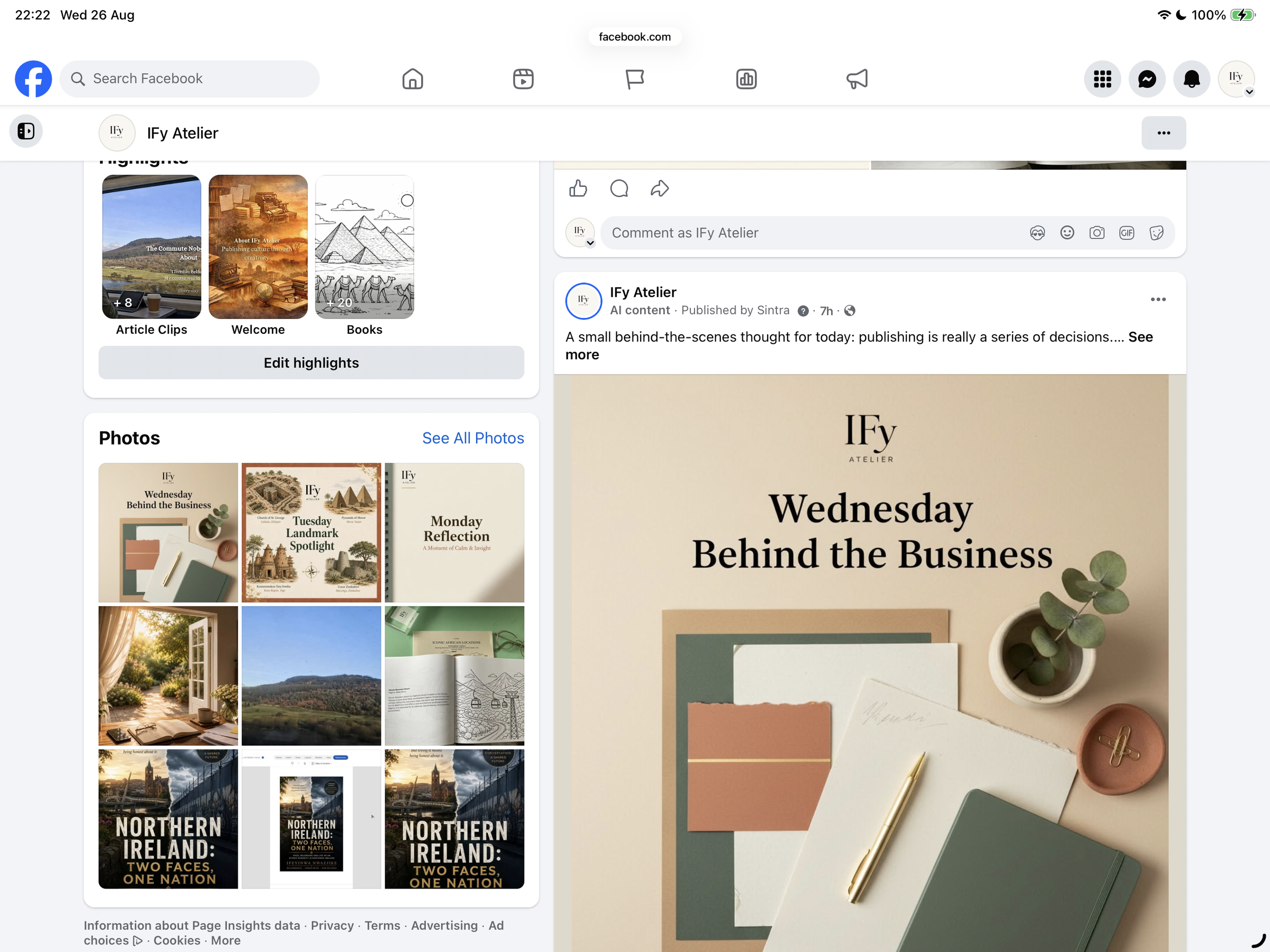
Apparently identifying the human founder is complicated. Identifying the involvement of AI is considerably easier.
Technically true.
Creatively, rather less informative.
Somewhere between “created by AI” and “created without AI” sits an increasingly large category of work that is conceived, selected, corrected, rewritten and ultimately approved by a human, with AI somewhere in the production chain.
I will readily admit that AI has also saved me money. Money I might otherwise have spent on editors, proofreaders, graphic designers, numerous consultation sessions and some of the countless cool and shiny services available to more established traditional publishing houses.
But it has also taught me something slightly unexpected about delegation.
Using a tool does not necessarily mean surrendering creative control, just as delegating a business function does not necessarily mean surrendering control of the business.
Sometimes it simply means deciding which parts genuinely need you and which parts can be handled differently.
That distinction is becoming increasingly important as IFy Atelier grows.
Growing beyond the founder without losing the founder
And perhaps that is the real milestone hidden underneath IFy Atelier’s first job opportunity.
I am beginning to think about what it means to build something that can function beyond me.
Not without me.
Beyond me.
There is a difference.
I want the freedom to spend more time thinking about strategy, publishing, creativity and growth rather than personally carrying every operational function forever.
I want other people eventually to bring skills to IFy Atelier that I don’t have.
I want someone better at sales than me to sell.
Eventually, I may want someone better at other things to take responsibility for those too.
That is how organisations grow.
But growth also requires learning which things can be delegated and which things the founder should continue protecting.
Perhaps that is one of the strange transitions between starting a business and actually building an organisation.
At first, independence means doing everything yourself.
Eventually, independence means building something that doesn’t need you to do everything yourself.
IFy Atelier has not suddenly become a huge company because I posted one freelance opportunity.
Far from it.
But it is the first time I have looked at something I have been doing myself and deliberately said:
Perhaps somebody else should do this now.
For a tiny independent creative business, that feels enormous.
So yes, Luis, apparently there was something developing in a corner of my organisation that I hadn’t been paying enough attention to.
It just wasn’t a catastrophic failure.
It was a job vacancy.
And apparently my baby is growing up.
Just don’t tell Google AI she’s old enough to leave home yet.